In today’s digital world, businesses rely heavily on technology to store sensitive information and deliver online services. Whether it is customer details, financial records, employee information, or business data, organizations are responsible for protecting this information from cyber threats and unauthorized access. As cyberattacks continue to increase, customers want to know that the companies they work with can be trusted to keep their data safe. This is where SOC 2 becomes important.
Imagine you’re renting a high-security safety deposit box at a bank to store your family’s most valuable heirlooms. Before you hand them over, you’d probably want some proof that the bank’s vaults are actually solid, that their security cameras work, and that they don’t just leave the keys lying around on the front counter.
In the digital world, SOC 2 is that proof.
What is SOC 2
SOC stands for System and Organization Controls. It is a framework created by the American Institute of Certified Public Accountants (AICPA). SOC 2 is an independent audit report that proves a company knows how to protect its customers’ data.
Unlike some compliance standards that provide a fixed list of technical requirements, SOC 2 focuses on how well an organization manages the security of the information it handles. Instead of simply checking whether a company has installed certain security tools, SOC 2 evaluates whether those tools and processes are working effectively over time. In simple terms, SOC 2 acts as proof that an organization takes data security seriously and follows recognized industry practices to protect customer information.
FIVE PILLARS OF SOC 2
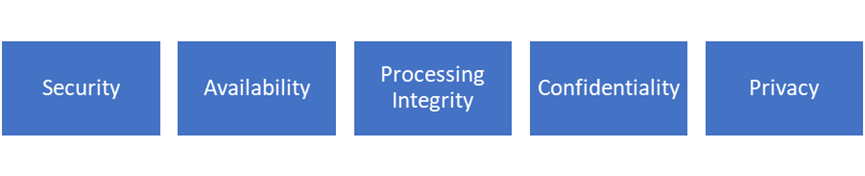
1. Security (The Foundation)
This is the only mandatory pillar for every SOC 2 audit. It focuses on protecting the company’s systems against unauthorized access or data theft. Organizations achieve this by implementing strong passwords, multi-factor authentication, firewalls, encryption, and continuous monitoring.
2. Availability
This pillar ensures that customers can actually access and use the company’s system or software when they need to. It’s all about maintaining operational uptime and operational resilience. Organizations improve availability by maintaining reliable infrastructure, monitoring system performance, creating backup systems, and preparing disaster recovery plans.
3. Processing Integrity
This criterion proves that the company’s system does exactly what it’s supposed to do, without errors. It ensures that data processing is complete, accurate, valid, and authorized. Quality assurance tracking, monitoring automated data inputs/outputs, and ensuring that user data doesn’t get corrupted or lost during a process or transaction.
4. Confidentiality
Not all data is public, and this pillar focuses on protecting information that is strictly designated as sensitive or proprietary. It ensures that access to this data is restricted to authorized people or teams. Examples include trade secrets, contracts, internal reports, and customer records. Organizations use encryption, access controls, and data classification policies to maintain confidentiality.
5. Privacy
While confidentiality protects business data, the privacy pillar specifically focuses on Personally Identifiable Information (PII)—like names, addresses, and social security numbers. It ensures the company handles a customer’s personal information in accordance with standard data privacy commitments. Privacy focuses on the responsible collection, storage, use, and disposal of personal information. Organizations must clearly explain how personal data is handled and ensure that it is processed according to applicable privacy laws and customer expectations.
SOC 2 Type I vs. Type II: UNDERSTANDING THE DIFFERENCE
1. SOC 2 Type I: The Snapshot
A Type I report evaluates whether a company’s security controls and systems are designed correctly and implemented at one specific point in time (for example, exactly on October 1st).
• The Analogy: Think of a Type I report like taking a photograph of a room. The photo proves the room is clean and organized at the exact moment the camera flashes.
• The Business Value: It is a fantastic starting point. It proves that management has successfully built and documented a solid security plan, and it can be achieved relatively quickly to show initial trust to clients.
2. SOC 2 Type II: The Video
A Type II report goes one step further by examining how effectively those same security controls actually function and operate over an extended period, typically anywhere from 3 to 12 months.
• The Analogy: If Type I is a photograph, Type II is a continuous video recording. The auditor doesn’t just check if the room can be clean; they watch the tape to make sure it stays clean every single day for six months. They want to see that your team is consistently following the rules, even when nobody is actively watching.
• The Business Value: This is the gold standard. Because it demonstrates consistent security practices and operational reliability over time, Type II is the report that major enterprise clients, banks, and enterprise partners will usually insist on seeing before signing a contract.
Achieving SOC 2 compliance is less like cramming for a final exam and more like building a healthy daily routine. The journey starts by deciding what to protect, focusing on the security rules that matter most to your clients. Next, you do a quick health check to spot any weak links—like missing employee training or unmonitored system access—and patch them up. Once your new security rules are up and running, you start gathering “digital receipts” like system logs, backup records, and training certificates to prove your setup actually works in the real world. Finally, an independent auditor steps in to review your proof and interview your team. Passing this review earns you your official SOC 2 report, giving you a powerful stamp of approval that instantly proves to big clients they can trust you with their data.
HOW GREYHOUND HELPS
Getting SOC 2 certified involves a lot of documentation and ongoing checks. If a SOC 2 Type I report is like a snapshot of your security at one point in time, a Type II report is like a video that shows how well your security controls work over a longer period. Greyhound helps by automatically monitoring your systems and collecting the evidence needed for compliance.
Instead of asking your team to manually collect records or maintain large compliance spreadsheets, Greyhound connects to your organization’s systems, continuously monitors your security posture, gathers the required evidence, and helps keep you ready for a SOC 2 audit.
The first step of any audit is defining your boundaries. You connect your organization’s infrastructure, domains, repositories, and cloud environments to the platform. This gives you an immediate, structured view of your entire attack surface, laying the groundwork for the Security pillar by ensuring nothing is left unmonitored.
The platform runs a combination of automated security posture scans and black-box penetration testing. It checks for known code weaknesses, structural gaps, and configuration issues, while simulating real-world external attacks. This acts as your mandatory pre-audit health check. As it evaluates your security posture, Greyhound collects concrete evidence of your vulnerabilities, configurations, and fixes. It provides a detailed evaluation of where your data security stands. When the auditor asks for validation that your firewalls are active, data is encrypted, or access controls are working, you pull these objective findings straight from the platform.
CONCLUSION
As businesses continue to embrace digital technologies and cloud-based systems, protecting customer data has shifted from a technical requirement to a baseline expectation. SOC 2 provides organizations with a structured, verified framework to demonstrate that they handle sensitive information with the utmost responsibility. While the journey to compliance requires careful planning and sustained effort, the long-term benefits far outweigh the investment.
At its core, achieving a SOC 2 report is an investment in corporate integrity. By weaving these five pillars into daily operations, an organization does more than just shield itself from modern cyber threats; it builds a resilient internal culture and reassures clients, partners, and stakeholders that their data is protected under recognized industry standards.
In today’s highly competitive digital landscape, data security is no longer a luxury reserved for tech giants—it is a powerful differentiator. Ultimately, a SOC 2 report serves as the gold standard of trust, opening doors to major enterprise opportunities and proving that an organization is a reliable, forward-thinking partner for the long haul.
Leave a Reply